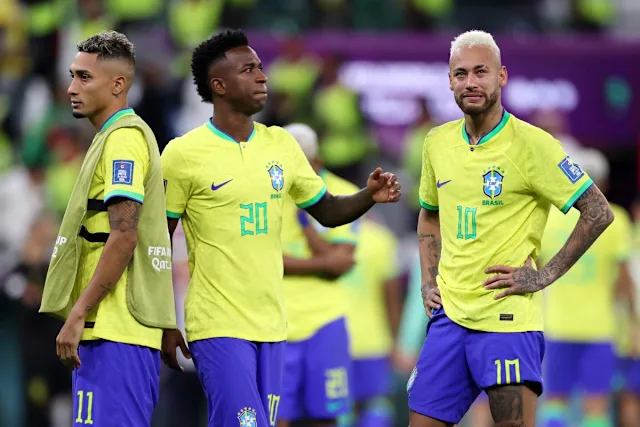
Every World Cup group has its own story, but few offer the blend of tradition, ambition, and emotion found in Group C. Featuring football powerhouse Brazil, rising global force Morocco, and the long-awaited returns of Scotland and Haiti, the group brings together four nations with very different journeys but one common objective: reaching the knockout stage.
On paper, Brazil enters as the favorite. Morocco arrives with growing confidence after establishing itself as one of the world’s most respected teams. Scotland returns to the biggest stage after years of frustration, while Haiti seeks to write a new chapter in its football history.
The result is a group that feels far more competitive than first impressions might suggest.
Brazil Carry the Weight of Expectation
Whenever Brazil enters a World Cup, expectations follow.
The five-time world champions have built a footballing legacy unmatched by any other nation. Generations of supporters have grown accustomed to seeing Brazil compete not only for qualification from the group stage but for the trophy itself.
That tradition brings pressure, but it also reflects the remarkable consistency of Brazilian football.
This current squad combines experienced leaders with exciting young talent. Across Europe and South America, Brazilian players continue to feature for some of the world’s biggest clubs, ensuring that the national team remains one of the tournament’s strongest contenders.
What makes Brazil particularly dangerous is their balance.
They possess attacking flair capable of unlocking any defense, but they also arrive with a growing emphasis on tactical organization and defensive discipline. Modern Brazilian teams may not always resemble the free-flowing sides of previous decades, yet they remain highly effective.
In Group C, Brazil will likely be viewed as the team everyone else is trying to catch.
That status makes every match a challenge.
Opponents often raise their level when facing football’s most famous national team, creating an environment where no game can be taken lightly.
Morocco’s Rise Is No Longer a Surprise
A few years ago, Morocco’s success may have been viewed as an underdog story.
Today, that description no longer fits.
Morocco has evolved into one of international football’s most impressive projects. Strong player development, improved infrastructure, and a clear footballing identity have transformed the national team into a genuine force on the global stage.
Their recent performances against elite opposition demonstrated that they are capable of competing with anyone.
Unlike traditional underdogs, Morocco enters major tournaments expecting success rather than simply hoping for it.
That shift in mentality may be their greatest strength.
The squad features players competing at the highest levels of European football, bringing valuable experience into every international window. Their tactical discipline makes them difficult to break down, while their pace and technical quality create constant threats on the counterattack.
For many observers, the showdown between Brazil and Morocco could determine the winner of Group C.
However, both teams understand that qualification will not be secured through a single match.
Consistency across all three group games will ultimately decide their fate.
Scotland Returns With Renewed Belief
For Scottish football supporters, World Cup qualification represents far more than participation.
It symbolizes the end of a long wait and the beginning of a new opportunity.
Scotland’s history includes memorable World Cup appearances, passionate support, and a deep footballing culture. Yet qualifying for the tournament has often proved difficult in the modern era.
Their return has generated excitement across the country.
The current Scottish squad possesses a level of quality and depth that supporters have not always enjoyed in previous generations. Many players are now regular starters in elite domestic leagues, bringing valuable experience and confidence to the national team.
What Scotland lacks in global star power compared to Brazil, they often compensate for with organization, intensity, and collective spirit.
Their matches are rarely straightforward for opponents.
Every point matters in a group stage, and Scotland will likely approach each fixture with the belief that progression is achievable.
That confidence could make them one of the most dangerous teams in the group.
Haiti’s Historic Opportunity
Few stories in Group C carry as much emotional significance as Haiti’s return to the World Cup.
For Haitian football, qualification represents a major achievement and a source of national pride.
Football has long occupied an important place in the country’s sporting culture, and participation on the world’s biggest stage provides an opportunity to showcase both talent and resilience.
While Haiti may enter the group as the lowest-ranked side, history repeatedly reminds us that World Cups rarely follow scripts.
Every tournament produces surprises.
Every tournament creates heroes.
And every tournament offers smaller nations the chance to challenge established powers.
For Haiti, the objective extends beyond results alone.
The opportunity to compete against elite opposition provides valuable experience and exposure for both players and the national football program as a whole.
At the same time, dismissing Haiti as outsiders would be a mistake.
Modern international football continues to become more competitive, with the gap between traditional giants and emerging nations narrowing in many areas.
A disciplined performance and a moment of quality can change the direction of an entire tournament.
Key Matches That Could Define the Group
Every World Cup group contains matches that shape the final standings.
In Group C, several fixtures stand out immediately.
Brazil vs Morocco
This is likely to be one of the most anticipated matches of the group stage.
Brazil brings history, talent, and expectation. Morocco brings momentum, confidence, and tactical sophistication.
The result could determine who finishes first, potentially influencing the path both teams face in the knockout rounds.
Scotland vs Haiti
Matches between teams competing for qualification opportunities often carry enormous significance.
For Scotland and Haiti, this fixture may prove decisive.
A victory could provide crucial momentum and create belief ahead of tougher challenges against Brazil and Morocco.
Morocco vs Scotland
This encounter may become a fascinating tactical battle.
Morocco’s technical quality and defensive organization will be tested by Scotland’s intensity and physical commitment.
In a group where every point matters, this match could have major implications for qualification.
Why Group C Is More Competitive Than It Appears
At first glance, many supporters may view Brazil and Morocco as clear favorites.
Football, however, rarely follows expectations perfectly.
World Cup history is filled with examples of established powers struggling against determined opponents. Group-stage matches often become battles of discipline, mentality, and preparation rather than pure talent.
Scotland possesses enough quality to challenge stronger opponents on the right day.
Haiti enters with nothing to lose and everything to gain.
That combination creates uncertainty.
And uncertainty is what makes the World Cup special.
No team can afford complacency.
No team can assume qualification.
Every nation must earn its place.
The Global Appeal of Group C
One reason Group C stands out is the diversity of footballing stories it contains.
Brazil represents tradition and excellence.
Morocco symbolizes growth and modern ambition.
Scotland embodies persistence and passionate support.
Haiti reflects resilience and opportunity.
Together, they capture many of the qualities that make international football unique.
Supporters from different continents, cultures, and footballing backgrounds will all see something familiar in this group.
That diversity enriches the tournament and adds emotional depth to every match.
Conclusion
Group C promises to be one of the most compelling groups of the World Cup. Brazil enters as the favorite, but Morocco has established itself as a legitimate challenger capable of competing with any nation. Scotland returns determined to prove it belongs among the world’s best, while Haiti arrives eager to seize a historic opportunity.
Each team brings its own ambitions, strengths, and storylines.
As the tournament begins, predictions will dominate discussions. Yet the beauty of the World Cup lies in its unpredictability. Over ninety minutes, reputations matter less than performances.
For Brazil, Morocco, Scotland, and Haiti, the journey is about to begin.
Only two can advance, but all four have reasons to believe their story in Group C is far from finished.