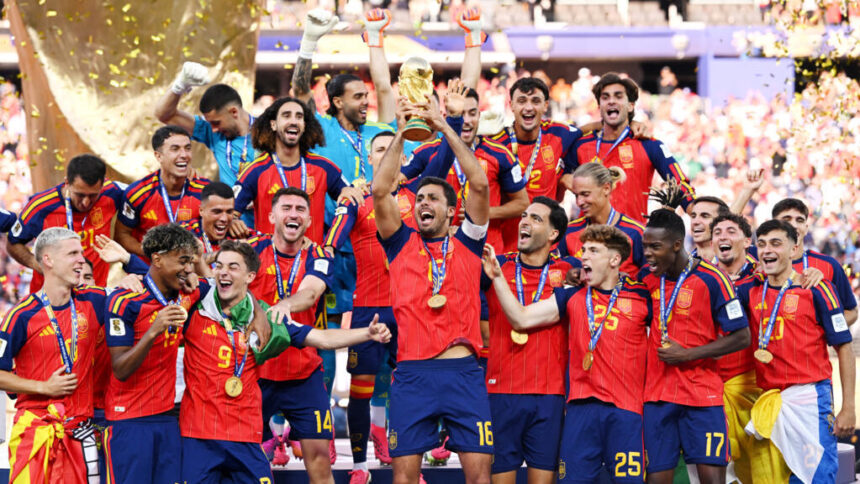
Spain Claims World Cup Glory with Dominant Performance Against Argentina
Spain celebrated a historic achievement by defeating Argentina in the FIFA World Cup final, securing the country’s second world title after a dramatic match that was decided in extra time. Although the Spanish side controlled possession and created the majority of the chances throughout the game, the breakthrough did not come until the second period of extra time, when Ferran Torres scored the decisive goal.
The final was marked by Spain’s relentless attacking approach, Argentina’s determined defensive resistance, and several outstanding saves from goalkeeper Emiliano “Dibu” Martínez, whose performance kept his team in contention for much of the contest. However, Spain’s persistence eventually paid off, allowing the European champions to lift the trophy once again.
Spain Controlled the Match from Start to Finish
From the opening whistle, Spain dictated the rhythm of the game. The team consistently pushed forward, maintaining pressure on Argentina’s defense and forcing their opponents to spend long periods without possession.
Argentina struggled to establish any attacking momentum. Their forwards found little space against Spain’s organized defensive structure, while the midfield was repeatedly forced to defend rather than create opportunities.
Despite several dangerous attacks, Spain could not convert its chances during regular time. Argentina’s defensive resilience, combined with remarkable goalkeeping, prevented the scoreline from changing before extra time.
Key Features of Spain’s Performance
- Consistent attacking pressure throughout the match.
- Strong control of possession and midfield.
- Organized defensive structure that limited Argentina’s opportunities.
- Patience in continuing to search for the winning goal.
Argentina Faced Constant Pressure
While Argentina entered the final with high expectations, the team found it difficult to impose its usual style of play. The Spanish defense effectively neutralized the South American attack, preventing meaningful chances on goal.
Even Lionel Messi, wearing the iconic number 10 shirt, was unable to influence the game as he normally does. Spain’s disciplined defensive organization limited his involvement, leaving Argentina without its usual attacking spark.
Throughout the match, Argentina rarely threatened the Spanish goalkeeper, highlighting the dominance displayed by Spain across the field.
Dibu Martínez Delivered an Outstanding Goalkeeping Display
Although Argentina struggled offensively, goalkeeper Dibu Martínez produced one of the standout individual performances of the final.
Time after time, Martínez denied Spain with impressive saves, preventing what appeared to be certain goals. His reactions kept Argentina alive despite the sustained pressure from the Spanish attack.
One of his most memorable moments came in the final seconds before extra time, when he successfully stopped a dangerous free kick from Lamine Yamal, Spain’s talented 19-year-old rising star. That save ensured the match remained scoreless at the end of regulation.
His efforts gave Argentina hope that the game could eventually be decided through a penalty shootout.
Red Card Left Argentina at a Major Disadvantage
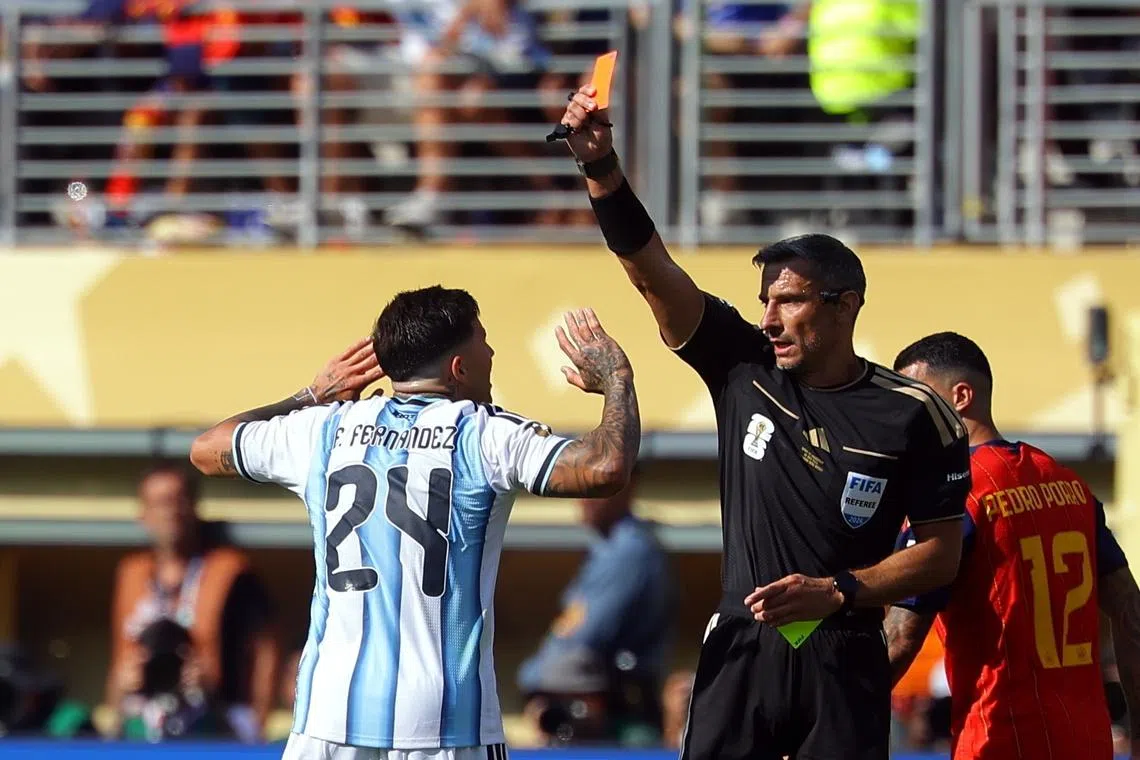
Argentina’s situation became significantly more complicated late in the match.
During stoppage time in the second half, Enzo Fernández received his second yellow card after making a hard challenge on Cubarsí, resulting in his dismissal.
Playing with ten men placed additional pressure on Argentina as Spain continued to dominate possession and attack relentlessly.
The numerical disadvantage reduced Argentina’s ability to defend effectively while also making counterattacks increasingly difficult.
Impact of the Sending-Off
The red card had several important consequences:
- Argentina lost an important midfielder during the decisive moments.
- Spain gained additional space in midfield.
- Defensive pressure increased dramatically.
- Argentina’s hopes of reaching penalties became much harder to maintain.
Ferran Torres Finally Breaks the Deadlock
As extra time began, Spain continued to control the match while Argentina concentrated on defending deep inside its own half.
For much of the additional period, it appeared that neither team would find the breakthrough, raising the possibility that the World Cup would be decided in a penalty shootout.
However, only seconds into the second half of extra time, Ferran Torres finally ended the deadlock.
His goal rewarded Spain’s persistence after more than two hours of continuous pressure and ultimately proved enough to decide the championship.
The strike sparked celebrations among Spanish players and supporters, while Argentina’s hopes of defending against the relentless attacks came to an end.
Spain Adds Another World Cup to Its History
This victory represents Spain’s second FIFA World Cup title, reinforcing the country’s place among football’s elite nations.
Spain’s first triumph came in 2010, when the team defeated the Netherlands in South Africa. Like this latest success, that historic final was also settled by a goal scored during extra time.
The similarities between the two victories underline Spain’s ability to remain composed under pressure and deliver decisive moments when it matters most.
Spain’s World Cup Triumphs
- 2010 – Defeated the Netherlands in extra time to win the country’s first World Cup.
- Latest Final – Defeated Argentina in extra time to secure a second world championship.
Defensive Discipline Played a Crucial Role
Although Spain received praise for its attacking football, the team’s defensive organization was equally important.
Argentina found very few opportunities to challenge the Spanish goalkeeper, reflecting the discipline shown by Spain’s defenders throughout the final.
Every attacking attempt from Argentina was quickly contained, allowing Spain to maintain territorial control while minimizing defensive risks.
This balanced approach enabled Spain to continue attacking confidently without exposing itself at the back.
Young Talent Continues to Shine
One of the notable figures during the final was Lamine Yamal, the 19-year-old Spanish talent who once again demonstrated why he is considered one of the country’s brightest young players.
Although he did not score, his dangerous free kick just before extra time forced another spectacular save from Dibu Martínez.
His presence throughout the match highlighted Spain’s combination of experienced players and emerging stars, providing optimism for the future of the national team.
A Final Defined by Patience and Persistence
The World Cup final showcased two contrasting approaches.
Spain dominated possession, controlled the tempo, and continuously searched for openings, while Argentina relied heavily on disciplined defending and exceptional goalkeeping to remain competitive.
For long periods, the scoreless match suggested penalties would decide the champion. Instead, Spain’s patience eventually produced the decisive goal that crowned months of preparation and consistent performances.
The final demonstrated that sustained pressure and tactical discipline can ultimately overcome even the strongest defensive resistance.
Conclusion
Spain’s victory over Argentina was the result of sustained control, defensive stability, and unwavering persistence. While Argentina displayed determination through the remarkable efforts of goalkeeper Dibu Martínez, the team struggled to create meaningful attacking opportunities and faced an even greater challenge after Enzo Fernández’s late dismissal.
Ferran Torres’ extra-time winner ensured that Spain’s dominance was finally reflected on the scoreboard, earning the nation its second FIFA World Cup title. The triumph also echoed Spain’s unforgettable 2010 success, with both championships secured through decisive goals in extra time.
By combining disciplined defending, patient attacking play, and the contributions of both experienced players and emerging talents, Spain delivered a championship-winning performance worthy of football’s biggest stage.